




3 weeks ago
Wednesday, March 09, 2011
John Lennon's concerns with drugs
No! Lucy in the Sky with Diamonds has nothing to do with LSD.
John asks "Why do people take drugs?"
Friday, March 04, 2011
Would you donate your brain for research?
The Netherlands Brain Bank has been collecting brains since 1985.
"In 1985, Dick Swaab, together with neuropathologist Professor Frans Stam (VUmc), officially established the Netherlands Brain Bank (NBB). By promoting the importance of brain tissue for scientific research to nursing home physicians and family members of demented residents, the number of registered brain donors with Alzheimer’s disease grew rapidly. In 1990 the NBB started the collection of brain tissue of other disorders as well, such as Parkinson’s disease, multiple sclerosis, Huntington’s disease and psychiatric disorders. Apart from brain tissue with neurologic or psychiatric disorders the NBB also collects tissue of healthy persons, so-called ‘controls’. This control tissue is indispensible if researchers are to be able to make a comparison with the diseased tissue."The researchers... yes, we all know who are the researchers.
Friday, February 11, 2011
Stuart Shipko MD explains sexual dysfunctions caused by SSRIs medicines that are being used to treat sexual-offenders
Yesterday Mr. Shipko left the following comment at the post I wrote in March 21, 2010:
 Dr. Shipko said...
I am pleased that someone is taking an interest in my public service video - and also pleased that someone else notes the work of Dr.Kafka. I just wish that the header didn't read that Dr. Shipko "admits" ... I reads as if it is my fault and that I am confessing. A better header would be that Dr. Shipko "exposes" or "clarifies" the severity of the problem.
S. Shipko MD February 10, 2011 9:03 PM
I'm republishing the post with the correction because I believe he is right and also because PSSD is still denied by many psychiatrists. This is a very serious issue that should be brought to the public especially because children and teenagers are being prescribed SSRI antidepressants.
"I believe this is the first time a psychiatrist speaks openly about sexual problems induced by SSRIs.
 Dr. Shipko said...
I am pleased that someone is taking an interest in my public service video - and also pleased that someone else notes the work of Dr.Kafka. I just wish that the header didn't read that Dr. Shipko "admits" ... I reads as if it is my fault and that I am confessing. A better header would be that Dr. Shipko "exposes" or "clarifies" the severity of the problem.
S. Shipko MD February 10, 2011 9:03 PM
I'm republishing the post with the correction because I believe he is right and also because PSSD is still denied by many psychiatrists. This is a very serious issue that should be brought to the public especially because children and teenagers are being prescribed SSRI antidepressants.
"I believe this is the first time a psychiatrist speaks openly about sexual problems induced by SSRIs.
I visited SSRI-sex Yahoo group and found this video here.
This is what is written at the side bar:
Stuart Shipko, MD (psychiatrist) presents recent findings on the effects of antidepressants on sexual behavior.
"Sexual side effects occurring in response to taking antidepressant medications are more common than previously reported and may not always resolve once the medication has been discontinued. Informed consent regarding the use of these medications is most effectively accomplished when all professionals responsible for a patients care are educated about these side effects and work collaboratively to educate patients, thus increasing their ability to make an informed choice. The frequency with which the medications are prescribed, the evidence that sexual side effects have been underestimated, and the deleterious effects that such medication side effects may have on treatment and patient functioning make it imperative that psychologists educate themselves in order to best help those whom they serve. This entails a necessary expansion of psychologists knowledge base and scope of practice. Current efforts at informed consent are most likely inadequate, particularly for the treatment of children and adolescents, and leave a void that psychologists, given our often more frequent contact with patients, are particularly suited to fill."1"
At the video he claims:
"These effects have been used by medical scientists. these drugs have been promoted in same cases as treatment for premature ejaculation. Martin Kafka, a Harvard psychiatrist, has promoted the use of these drugs to reduce sexual impulsivity in sexual offenders."
I have wrote about Martin Kafka's treatment at this post.
It is very strange that this "treatment" is being used since 1996 and psychiatrists are still denying that SSRI do cause sexual problems or claiming that "I never heard about that in my clinical experience" is so common. This is not a recent finding.
As I said at the post:
I've stressed "deviant sexual thoughts and fantasies" because it's widely reported on SSRI-sex Yahoo group people claiming that their normal sexual fantasies and thoughts have been altered or disappeared.
Claiming that "SSRIs may help alter a dysfunctional serotonergic system" is not a good explanation. Why on earth people who have conventional sexual fantasies are also affected when they take SSRIs?
It's written here:
"Since serotonine affects sexual appetite,..." and this is what really happens along with changes in sexual thoughts and fantasies which should be investigated because normal people are having sexual problems such as anorgasmia, lost of libido, lack of sexual thoughts and fantasies even after years off SSRIs.
It should be considered as a serious iatrogenic condition and not praised because it can fix paraphilias."
Claiming that "SSRIs may help alter a dysfunctional serotonergic system" is not a good explanation. Why on earth people who have conventional sexual fantasies are also affected when they take SSRIs?
It's written here:
"Since serotonine affects sexual appetite,..." and this is what really happens along with changes in sexual thoughts and fantasies which should be investigated because normal people are having sexual problems such as anorgasmia, lost of libido, lack of sexual thoughts and fantasies even after years off SSRIs.
It should be considered as a serious iatrogenic condition and not praised because it can fix paraphilias."
Monday, February 07, 2011
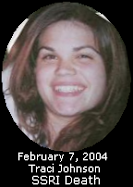
Feb. 7, 2004 - In memory of Traci Johnson - Cymbalta victim

This is the third year I publish this post at the same date.
Traci Johnson, a healthy volunteer, joined Cymbalta's Eli-Lilly urinary incontinence clinical trial in early January, 2004 in a clinic at Indiana University Medical Center.
In February, 7 her body was found. She hung herself with a scarf from a shower rod at Eli-Lily's facilities.
........................................................................RIP Traci Johnson (your candle is still burning)
Monday, January 24, 2011
Erica Bain: Jodie Foster at The Brave One


"There is no going back to that other. She is gone. This thing, this stranger, it's all you are now."
The Brave One is about Erica Bain a New York radio host that witnessed her boyfriend being brutally killed and it changed her life.
I like this quotation and I believe it expresses what some people feel after some events.
Keep going all strangers!
Monday, January 10, 2011
FOX News: A long list of school shooters were on SSRIs including Columbine's Eric Harris
"We found that a disturbing number of school shooters were either on medication or were experiencing withdrawal."
"The list include 15 years old Kip Kinkel withdrawing from Prozac when he shot 22 classmates and killing 2."
 |
| Eric Harris at Columbine - Luvox |
and 17 years old Eric Harris on Luvox ... Columbine..."
It is at FOX News and Peter Bregguin talks at the end. If this is not enough evidence...
I saw a documentary about Eric Harris, the Columbine shooter. His father said that Eric was on Zoloft and told him that he was feeling strange and violent. They changed Zoloft to Luvox. Great solution!
Sunday, January 09, 2011
ODD "Oppositional Defiant Disorder" a child disease to be treated with Ritalin
The American Academy of Child and Adolescent Psychiatry wrote an alert about this disease:
"In children with Oppositional Defiant Disorder (ODD), there is an ongoing pattern of uncooperative, defiant, and hostile behavior toward authority figures that seriously interferes with the youngster's day to day functioning.
All children are oppositional from time to time, particularly when tired, hungry, stressed or upset. They may argue, talk back, disobey, and defy parents, teachers, and other adults. Oppositional behavior is often a normal part of development for two to three year olds and early adolescents.
However, openly uncooperative and hostile behavior becomes a serious concern when it is so frequent and consistent that it stands out when compared with other children of the same age and developmental level and when it affects the child's social, family, and academic life."
"In one study, Ritalin was used to treat children with both ADHD and ODD. Researchers found that when treated with Ritalin, 90% of the children no longer had the ODD. However, this was a poorly executed study. The researchers dropped a number of children from the study because they were too defiant to take their medication as scheduled. Still, even if these children are included as treatment failures, the study still showed a 75% success rate with Ritalin."
according to this site.
"In children with Oppositional Defiant Disorder (ODD), there is an ongoing pattern of uncooperative, defiant, and hostile behavior toward authority figures that seriously interferes with the youngster's day to day functioning.
All children are oppositional from time to time, particularly when tired, hungry, stressed or upset. They may argue, talk back, disobey, and defy parents, teachers, and other adults. Oppositional behavior is often a normal part of development for two to three year olds and early adolescents.
However, openly uncooperative and hostile behavior becomes a serious concern when it is so frequent and consistent that it stands out when compared with other children of the same age and developmental level and when it affects the child's social, family, and academic life."
In children with Oppositional Defiant Disorder (ODD), there is an ongoing pattern of uncooperative, defiant, and hostile behavior toward authority figures that seriously interferes with the youngster’s day to day functioning. Symptoms of ODD may include:
- Frequent temper tantrums
- Excessive arguing with adults
- Often questioning rules
- Active defiance and refusal to comply with adult requests and rules
- Deliberate attempts to annoy or upset people
- Blaming others for his or her mistakes or misbehavior
- Often being touchy or easily annoyed by others
- Frequent anger and resentment
- Mean and hateful talking when upset
- Spiteful attitude and revenge seeking
"In one study, Ritalin was used to treat children with both ADHD and ODD. Researchers found that when treated with Ritalin, 90% of the children no longer had the ODD. However, this was a poorly executed study. The researchers dropped a number of children from the study because they were too defiant to take their medication as scheduled. Still, even if these children are included as treatment failures, the study still showed a 75% success rate with Ritalin."
according to this site.
Saturday, January 08, 2011
UK campaigns for the rights of smokers:evidences that the risks are being overrated

For many, the clinching argument in favour of a ban on SIPPs was the supposed evidence that SHS presented a measurable health risk to those exposed to it.
There is an enormous amount of published research on the possible health risks of SHS, showing varying and contradictory results.
There is an ongoing epidemiological debate about the risks, if any, of exposure to SHS. Probably the main report affecting public policy on SIPS in the United Kingdom was the Scientific Committee on Tobacco and Health (SCOTH) report published in November 2004.
SCOTH concluded that the increased risk of contracting lung cancer for those exposed to SHS was 24% and for heart disease was 25%.
Even if these numbers are accepted, they are utterly trivial compared to the risks we are willing to accept – or expose others to - in many other areas of our lives.
For example, according to Cancer Research UK, the increased risk of contracting lung cancer if you work in a profession that regularly exposes you to diesel fumes is 47% - twice that of exposure to SHS assumed in SCOTH.
Those living in areas with high levels of nitrogen oxide (usually caused by vehicle emissions) have an increased chance of about 33% of contracting lung cancer. (emphasis mine)
Workers in the ship-building or construction industry have been estimated to have an increased chance of contracting lung cancer of up to 50% - twice that assumed for workers exposed to SHS by SCOTH.
One study even suggests that women who don’t smoke, but have a wood-burning fire at home, may have an increased risk of lung disease in excess of 300%. (emphasis mine)
A French study in 2003 suggested a typical barbecue in one’s garden releases the same number of dioxins that would be emitted from 220,000 cigarettes. (emphasis mine)
So, even if one accepts the SCOTH report’s numbers on the increased risk suffered by those working in smoke-filled pubs and clubs, these risks pale into utter insignificance compared to risks we readily and unquestionably accept elsewhere.
Furthermore, any presumed risk - to those working in environments with SHS - needs to be compared to the alternative. In a deteriorating economy, the alternative for many of those who no longer work in pubs and clubs is measurably less income as a result of unemployment.
In terms of overall public health, there is no evidence to suggest that the SIPPs ban has reduced the overall smoking rate. In fact, in Scotland, smoking has risen amongst the 16-24 year old age group since the ban was imposed.
The conclusion is clear. Even if one accepts the evidence of the SCOTH report, the risks do not justify a comprehensive, blanket ban on SIPPs. This is likely to hit already low paid bar staff, who are risk losing their jobs, hardest."
For more information visit the site Amend the Smoking Ban.
Big Pharma inside WHO: Wikileaks
I know, you know, we all know that the World Health Organization, WHO, supports Big Pharma. Here is one of some of Wikileaks's Big Pharma's documents:
"Released December 9, 2009
Summary
"Released December 9, 2009
Summary
This is a confidential pharmaceutical industry trade association dossier about the WHO Expert Working Group (EWG) on R&D Financing.
The International Federation of Pharmaceutical Manufacturers & Associations (IFPMA; "Big Pharma") gave its members 4 documents: a non-public draft report of the WHO EWG and a non-public Comparative Analysis done by the working group, the IFPMA Overview of the EWG Comparative Analysis, and IFPMA summary slide on the EWG Draft Report.
The compilation of documents shows the influence of "Big Pharma" on the policy making decisions of the WHO, the UN body safeguarding public health. These confidential documents were obtained by the drug industry before their public release to WHO member states (scheduled to be released May 2010). The document also illustrates that the WHO expert group was highly responsive to industry lobbying — a result that public health groups had feared since early 2009, when the expert group met with the industry, but refused to meet with public health groups known to be industry critics.
The likely audience for these documents include countries, public health policy makers, civil society, industry, academia, media, patients and the general public.
Journalists can contact Dr Margaret Chan, Director-General of WHO: chanm@who.int and Malebona Precious Matsoso, WHO Director, Public Health, Innovation and Intellectual Property: matsosom@who.int
According to our source, the English version of the final report of the EWG with its recommendations is expected to be released to member state countries this week."Thursday, January 06, 2011
Drug-induced suicide attempt: how to differentiate real suicide from drug-induced (repost)
"Drug-induced suicide ideation should be explained by those who are in charge of taking care of heath. However little is said about this fact that has been experienced by many people. I'm reposting it because some people can doubt that what they are feeling is really drug-induced.
There is a huge difference between wanting to die and just the act of killing oneself that is planted in the mind when we are dealing with drug-induced suicidal ideation. Trust your instincts and, please, search for help if you feel you are suicidal because of an antidepressant or any other drug.
This is my experience and I only published to make others understand that drug-induced suicidal ideation is REAL!I didn't write about the second because it is too hard.
"One of the strange feelings when someone or something do you harm is the mixture of feelings you have towards yourself. You feel as if it was your fault and you feel ashamed to tell others what has happened. Of course there is anger towards what did you harm but it's usual that people don't tell others about it.
We remain silent and hoping that someone else suffers the same and have the guts to tell others.
I said that I had suicidal ideation while tapering Effexor. What I didn't say is that I've tried to kill myself twice. I thought about it on a wide scale of degrees. Four times it was very hard to cope with it and for two times I've tried.
I'll tell you about one of these times.
I was in a normal day, tapering Effexor. All of a sudden, an idea was planted in my brain: "-I have to kill myself." Just like that. Unexpectedly, no reason for it, I was happy and then this idea appeared.
You don't think about anything else. You only think that you have to kill yourself. I wrote some notes for four people, and was thinking at the back of my mind: "-This is withdrawal, this is withdrawal, this is withdrawal…; call your therapist, call a friend, do something!"
Strangely enough you don't call anybody. You do not care. All you have to do is… kill yourself.
I have a dog. So I could not do anything at home for I could not harm her or make something that could kill her, like gas - my second attempt was with gas -, and you keep on wandering how are you going to do it without making any fuss and avoiding the scandal of being found dead in your place. Good, at least there's room to think about a dignified exit!
I had many samples of psychiatric drugs, drugs that I tried, and, at the forth pill had to stop… I had an arsenal of psychiatric drugs of many kinds.
Therefore, I took them all and put them in two bottles of Depakote - by that time it was sold in bottles not in blister. "-It's withdrawal, it's withdrawal, it's withdrawal… do something; call someone; call your therapist, please!" "-Nope! I have to kill myself."
I've phoned a hotel and ask for a bedroom. I've dressed myself with care and took a big bag pretending to be coming from a near town. I have put some clothes in this bag and a bottle of Jack Daniels to have the pills, Rohypnol was in the cocktail which is very helpful and was once used by the site Exit . They used to sell a packed for those who wanted to do euthanasia and I've discovered that one of the three items was Rohypnol. They are back now but with another proposal.
"-It's withdrawal, it's withdrawal, it's withdrawal… do something; call someone; call your therapist, please!" "-Nope! I have to kill myself."
It was 9 pm. I went away from my building, took a cab, and told the driver to go to the hotel. He left me there.
When I was in front of the hotel, I felt thirsty and did not want to appear as if I was out of my mind. I went to a place and asked for a bottle of water.
I thought that the man could not hear me. By miracle, he gave me the bottle of water. I took it and, miracle, I've paid for this and he smiled at me. He smiled at me!
So people could see me! "-It's withdrawal, it's withdrawal, it's withdrawal… do something; call someone; call your therapist, please…
Isn't it good!
I'm alive! I started walking. I've walked, walked, walked, and started to sweat.
Nice feeling! I was sweating and feeling all my body, my legs, my arms, my head, my hands, my toes…
"-It's withdrawal, it's withdrawal, it's withdrawal…"
What am I doing here? Why will I kill myself? I don't want to kill myself.
My dog is home! She must be feeling sad. I have to go back home to see her and call my friends and family."
"I want to thank Charles Medawar, SocialAudit. There was a man on his site whose nick was "Anon". He helped everybody and one of the things I've remembered was he saying that we should never become a statistics and if we killed ourselves "they" were winning another time.
He said other valuable things that was on my mind beside the "-It's withdrawal..."
Fortunately I don't remember anymore and I'm glad to be able to talk about it without crying and now I am feeling that it's in the past.
The only thing I fear is that even spending 19 months tapering Efexor when I reached the end of the process I felt so bad that I had to go back to the drug.
I'll talk about it later.
If I miss I pill I have nightmares. I fear missing the amount of dose and feel it again.
You can see that it's very easy to kill me if someone has the intention.
I also lost my freedom because I cannot make a trip or go anywhere without Effexor in my purse."
Update January, 6, 2011
I forgot to post about some violent behavior I had at that time. I wrote about my experiences at the first year I was blogging.
I don't feel like writing about it any longer. But I will do it if it helps people.
But those who come to this blog already know. So, it is almost useless. I gave up trying to raise awareness.
I'm trying to catch attention of those who profit from all of this.
YOU ALL BELONG TO JAIL!!!!!!!!
There is a huge difference between wanting to die and just the act of killing oneself that is planted in the mind when we are dealing with drug-induced suicidal ideation. Trust your instincts and, please, search for help if you feel you are suicidal because of an antidepressant or any other drug.
This is my experience and I only published to make others understand that drug-induced suicidal ideation is REAL!I didn't write about the second because it is too hard.
"One of the strange feelings when someone or something do you harm is the mixture of feelings you have towards yourself. You feel as if it was your fault and you feel ashamed to tell others what has happened. Of course there is anger towards what did you harm but it's usual that people don't tell others about it.
We remain silent and hoping that someone else suffers the same and have the guts to tell others.
I said that I had suicidal ideation while tapering Effexor. What I didn't say is that I've tried to kill myself twice. I thought about it on a wide scale of degrees. Four times it was very hard to cope with it and for two times I've tried.
I'll tell you about one of these times.
I was in a normal day, tapering Effexor. All of a sudden, an idea was planted in my brain: "-I have to kill myself." Just like that. Unexpectedly, no reason for it, I was happy and then this idea appeared.
You don't think about anything else. You only think that you have to kill yourself. I wrote some notes for four people, and was thinking at the back of my mind: "-This is withdrawal, this is withdrawal, this is withdrawal…; call your therapist, call a friend, do something!"
Strangely enough you don't call anybody. You do not care. All you have to do is… kill yourself.
I have a dog. So I could not do anything at home for I could not harm her or make something that could kill her, like gas - my second attempt was with gas -, and you keep on wandering how are you going to do it without making any fuss and avoiding the scandal of being found dead in your place. Good, at least there's room to think about a dignified exit!
I had many samples of psychiatric drugs, drugs that I tried, and, at the forth pill had to stop… I had an arsenal of psychiatric drugs of many kinds.
Therefore, I took them all and put them in two bottles of Depakote - by that time it was sold in bottles not in blister. "-It's withdrawal, it's withdrawal, it's withdrawal… do something; call someone; call your therapist, please!" "-Nope! I have to kill myself."
I've phoned a hotel and ask for a bedroom. I've dressed myself with care and took a big bag pretending to be coming from a near town. I have put some clothes in this bag and a bottle of Jack Daniels to have the pills, Rohypnol was in the cocktail which is very helpful and was once used by the site Exit . They used to sell a packed for those who wanted to do euthanasia and I've discovered that one of the three items was Rohypnol. They are back now but with another proposal.
"-It's withdrawal, it's withdrawal, it's withdrawal… do something; call someone; call your therapist, please!" "-Nope! I have to kill myself."
It was 9 pm. I went away from my building, took a cab, and told the driver to go to the hotel. He left me there.
When I was in front of the hotel, I felt thirsty and did not want to appear as if I was out of my mind. I went to a place and asked for a bottle of water.
I thought that the man could not hear me. By miracle, he gave me the bottle of water. I took it and, miracle, I've paid for this and he smiled at me. He smiled at me!
So people could see me! "-It's withdrawal, it's withdrawal, it's withdrawal… do something; call someone; call your therapist, please…
Isn't it good!
I'm alive! I started walking. I've walked, walked, walked, and started to sweat.
Nice feeling! I was sweating and feeling all my body, my legs, my arms, my head, my hands, my toes…
"-It's withdrawal, it's withdrawal, it's withdrawal…"
What am I doing here? Why will I kill myself? I don't want to kill myself.
My dog is home! She must be feeling sad. I have to go back home to see her and call my friends and family."
"I want to thank Charles Medawar, SocialAudit. There was a man on his site whose nick was "Anon". He helped everybody and one of the things I've remembered was he saying that we should never become a statistics and if we killed ourselves "they" were winning another time.
He said other valuable things that was on my mind beside the "-It's withdrawal..."
Fortunately I don't remember anymore and I'm glad to be able to talk about it without crying and now I am feeling that it's in the past.
The only thing I fear is that even spending 19 months tapering Efexor when I reached the end of the process I felt so bad that I had to go back to the drug.
I'll talk about it later.
If I miss I pill I have nightmares. I fear missing the amount of dose and feel it again.
You can see that it's very easy to kill me if someone has the intention.
I also lost my freedom because I cannot make a trip or go anywhere without Effexor in my purse."
Update January, 6, 2011
I forgot to post about some violent behavior I had at that time. I wrote about my experiences at the first year I was blogging.
I don't feel like writing about it any longer. But I will do it if it helps people.
But those who come to this blog already know. So, it is almost useless. I gave up trying to raise awareness.
I'm trying to catch attention of those who profit from all of this.
YOU ALL BELONG TO JAIL!!!!!!!!
Wednesday, December 22, 2010
Mick Jagger never took Ritalin! Thanks the Lord! Merry Christmas

Whenever I see Mick Jagger performing I cannot help noticing that he runs, jumps comes and goes and never stops. I'm glad to know that he has already done what he did, keeps moving, rocking and rolling and is no longer at the age of being seen as a possible hyperactive child and the drugs he took were those he wanted to have and when he wanted them. Can you imagine what would be the effects of giving Ritalin to this man when he was a teen? Take a look at the video and see how difficult it is for Tina Turner follow Mick around the stage. He keeps teasing her asking her to follow him.
I like this song and this is is the rhythm I hope you have at Christmas.
I like this song and this is is the rhythm I hope you have at Christmas.
Merry Christmas! STOP DRUGGING CHILDREN!!
Monday, December 20, 2010
Antidepressants SSRIs causes suicide: FOX NEWS

This was at FOX NEWS this year as well as many other tiny little notices here and there at the mainstream media.
Still these drugs are being prescribed and physicians claim that they have been saving millions of lives.
If antidepressants SSRIs are really helping people good for those who were helped. But I hope that the story of the other millions these drugs have destroyed the lives appear more frequently on the mainstream media.
"The document suggests that a patient taking Paxil is eight times more likely to attempt or commit suicide than patients taking placebo."
"At that time GSK vehemently denied that Paxil caused suicide in a statement to Fox News."
"I'm outraged because that kind of statement absolutely put lives at risk and that should not be tolerated."
Wednesday, December 15, 2010
US Government will conduct clinical trial to prove that informed consent can be considered as nocebo for SSRIs

I just came across with this clinical trial that should have started last October but, so sad, it didn't. Informed consent might trigger side efffects is the hypothesis they will study until 2013.
If you are not familiar with the concept of nocebo:
"A nocebo (Latin for "I will harm") is something that should be ineffective but which causes symptoms of ill health. A nocebo effect is an ill effect caused by the suggestion or belief that something is harmful. The term 'nocebo' became popular in the 1990s. Prior to that, both pleasant and harmful effects thought to be due to the power of suggestion were usually referred to as being due to the placebo effect.Because of ethical concerns, nocebos are not commonly used in medical practice or research. Thus, it is not unexpected that the nocebo effect is not well-established in the scientific literature. However, there are some anecdotes and some studies that are commonly appealed to in the literature to support its validity." (here)
This is the clinical trial:
Detailed Description:
"In this study the investigators wish to inquire whether the nature of the explenation given to the patient as part of informed consent has an effect on the prevalence of side-effects. The study will take place in the out-patient clinic at the Shalvata Mental health Center. Three arms are included:
- 50 patients started on SSRI's will be updated about its common side effects
- 50 patients started on SSRI's will be updated about its common side effects and will receive an explenation on the nocebo effect
- 50 patients started on SSRI's will receive an explenation on the nocebo effect, but will not be updated about common side-effects. Nonetheless, they will be informed of severe side-effects.
Following the prescription of an SSRI the subjects will we enter the follow-up phase of the study. They will attend two follow-up meetings: 3 days after the initiation point and one month after the starting point. During each meeting they will be asked to fill the Antidepressant Side-Effect Checklist (ASEC)and the General Health Questionnaire (GHQ)."
If you were thinking about informed consent for drugs whose side effects are birth defects, suicidal ideation, violent behaviour, impossible withdrawal I believe you will have to wait.
Tuesday, December 14, 2010
Raising Awareness: FAIL / Psychiatry has to make a decision

.Matisse - Joy of Life is the most visited post of this blog.
I visited The Carlat Psychiatry blog and came across with this post where you read:
"But when I see a patient in my office, I do just the opposite. I try to maximize the placebo effect. I say things like, "I've had great success with Zoloft in patients like you....I would say you have an 80-90% chance of feeling much better within the next 2 weeks....These drugs are remarkably effective...."
This is from one of the psychiatrists who ís at my blog list and is considered ethical. It seems to me that psychiatry fears stop prescribing these drugs even after all the harms that are already undeniable.
Psychiatry keeps going as if nothing is happening. I don't know what to say. I'm tired and unfortunately nothing I say is considered "evidence". This is sad because I see people getting addicted to clonazepam, a benzodiazepine that is very hard to withdraw, and is being prescribed for any kind of anxiety. They claim "diazepam" doesn't work... they say... they say...
Informed consent? "This drug helped so many of my patients!"
Informed consent? "This drug helped so many of my patients!"
Wednesday, December 01, 2010
Vets sue CIA Over Mind Control Tests
"For two decades or more during the Cold War, the CIA and the military allegedly plied the unwitting with acid, weed, and dozens of psychoactive drugs, in a series of zany (and sometimes dangerous) mind-control experiments. Now, the Vietnam Veterans of America are suing the agency and the Pentagon for perceived abuses suffered under the so-called "MK-ULTRA" and other projects.
Six veterans are suffering from all kinds of ailments tied to this
"diabolical and secret testing program," according to a statement from the vets’ lawyers, passed on toSpyTalk’s Jeff Stein.
The experiments allegedly included "the use of troops to test nerve gas, psychochemicals, and thousands of other toxic chemical or biological substances, and … the insertion of septal implants in the brains of subjects in … mind control experiments that went awry, leaving many civilian and military subjects with permanent disabilities." Subjects were tested without their consent, the veterans say. And when the trials were over, the government failed to "provide health care or compensation."
In a book published last year, former military psychiatrist James Ketchum describes an Army project — separate from the CIA’s efforts — that took place at Edgewood Arsenal in Maryland. There, he saw test subjects "carry on conversations with various invisible people for as long as 2-3 days." Others "salute latrines" and attempt to "revive a gas mask" that they mistake for a woman.
The feds insist that MK-ULTRA ended, when it was exposed during
Congressional hearings. But interest in chemical mind-control lives along, in some corners of the military-intelligence community. In a 2003 memo, then-Justice Department lawyer John C. Yoo suggesting that
interrogation drugs could be used if their effects were not permanent or profound. Since then, evidence has accumulated that some detainees may have been drugged. "It’s coming back," retired Colonel John Alexander told Sharon."
Source: WIRED.
Tuesday, November 30, 2010
A message to Mr Obama and US Congress

Don't laugh!
I just sent a message to Mr Obama at the White House site:
Why didn't anybody had the idea of telling Obama about it? I'm sure he is not aware of what is happening. Now we can wait for a change."I just want to remind you that the number of those who are suffering the hell because of psychdrugs like Prozac, Cymbalta, Paxil, Zoloft, Effexor - all the SSRIs and anti-psychotics - is increasing day after day.Still the US President and congressmen don't care.You are harming not only US citizens, harming in a hideous way that can be considered as crime against humanity, but the world population.Will you ever consider health an important issue?There is no other name for what these drugs are doing: crimes.Is that all the American government has to offer?"
(How any of these politicians can claim for respect when what they do are below any ethics, dignity and their speeches are made of words, words and words that mean nothing? Still their actions destroy.)
Here, Obama's government recruiting children 7-17 years old to a clinical trial of Prozac and Cymbalta. It started in 2009 and will end in 2011. Eli-Lilly causing more victims.
Sunday, November 28, 2010
For my dear Susan: you are on my mind sweetie
The Pope blesses the giant GlaxoSmithKline
 I just visited Bob Fiddaman's blog and read this post he did about this photo:
"a photo of GlaxoSmithKline's Head of European Clinical Psychiatry, Alastair Benbow and the Pope. The photo has not been doctored, Benbow did actually meet the Pope. In Benbow's own words:..." (read more at Fid's)
I was shocked for 2 seconds but soon recovered my reason.
For those who have their lives and health ruined by paroxetine - Seroxat/Paxil/Aropax - and are Catholics it seems that the prayers will have to be done out of the churches because the GSK and, of course, shareholders, politicians and all of those who are profiting while you are suffering are praying there and the Pope are on their side.
Pray at your own home.
Hat tip to Bob, as always.
Tuesday, November 09, 2010
American Government recruiting children to take drugs that are not to be taken by children

I reported this clinical trial here "Eli-Lilly studies SSRIs Cymbalta and Prozac in children 7-17 years old". This clinical trial started in 2009 and will end in 2011.
About ClinicalTrials.gov
ClinicalTrials.gov offers up-to-date information for locating federally and privately supported clinical trials for a wide range of diseases and conditions. A clinical trial (also clinical research) is a research study in human volunteers to answer specific health questions. Interventional trials determine whether experimental treatments or new ways of using known therapies are safe and effective under controlled environments. Observational trials address health issues in large groups of people or populations in natural settings.
ClinicalTrials.gov currently contains 98,303 trials sponsored by the National Institutes of Health, other federal agencies, and private industry. Studies listed in the database are conducted in all 50 States and in174 countries ClinicalTrials.gov receives over 50 million page views per month 65,000 visitors daily.
The U.S. National Institutes of Health (NIH), through its National Library of Medicine (NLM), has developed this site in collaboration with the Food and Drug Administration (FDA), as a result of the FDA Modernization Act, which was passed into law in November 1997. See the FDA document - Guidance for Industry: Information Program on Clinical Trials for Serious or Life-Threatening Diseases and Conditions(March 2002).
You can read more about Clinicaltrial.org here.
This clinical trial started in 2009 and will end in 2011. I don't understand why do they need 3 years to test a drug that has already been tested. It would be time for the phase IV of clinical trials:
Phase IV
Phase IV trial is also known as Post Marketing Surveillance Trial. Phase IV trials involve the safety surveillance (pharmacovigilance) and ongoing technical support of a drug after it receives permission to be sold. Phase IV studies may be required by regulatory authorities or may be undertaken by the sponsoring company for competitive (finding a new market for the drug) or other reasons (for example, the drug may not have been tested for interactions with other drugs, or on certain population groups such as pregnant women, who are unlikely to subject themselves to trials). The safety surveillance is designed to detect any rare or long-term adverse effects over a much larger patient population and longer time period than was possible during the Phase I-III clinical trials. Harmful effects discovered by Phase IV trials may result in a drug being no longer sold, or restricted to certain uses: recent examples involvecerivastatin (brand names Baycol and Lipobay), troglitazone (Rezulin) and rofecoxib (Vioxx).
Source: Wikipedia.
They don't care about the fourth phase of clinical trials and even consider what patients say as "anecdotal evidence". Drugs are supposed to be on the market even if they are killing people. The sole purpose of selling medicines is making money for those powerful few who profit.
Exposing children to these drugs is criminal.
Thursday, November 04, 2010
Jim Gottstein: "These drugs are so harmful that they literally kill people"
STOP DRUGGING CHILDREN!
"They are really a chemical lobotomy because that is what they do in the brain."
"18 year old having heart attack from these drugs."
"People put on these drugs have a life expectancy of 25 years shorter than the general population.
These drugs are so harmful that they literally kill people."
Jim Gottstein

Since late 2002, Mr. Gottstein has devoted the bulk of his time pro bono to the Law Project for Psychiatric Rights (PsychRights) whose mission is to mount a strategic litigation campaign against forced psychiatric drugging and electroshock across the United States. In June of 2006, the Alaska Supreme Court decided Myers v. Alaska Psychiatric Institute, which ruled Alaska's forced drugging procedures unconstitutional. Myers has been called"the most important State Supreme Court decision" on forced drugging in 20 years.
Visit PsychRights. It seems that the vast majority of psychiatrists still didn't understand what these drugs are doing. So we need lawyers to explain them what their prescriptions are doing to their patients. Drugging children the way they are doing is unacceptable and a crime. So we need jurisprudence to deal with it.
I thank all lawyers that are committing to the health of people.
Subscribe to:
Posts (Atom)


 Posts
Posts


